When survival requires movement
Have you noticed that in certain situations a strong urge arises in your body to move on quickly?
Not to reflect, not to stay — but to decide, change direction, leave.
Do you feel that speed brings relief?
That it feels much easier to handle a hundred things at once than to take five minutes to breathe?
That leaving, or the sense of interruption, creates a brief moment of space?
Does “clarity” arrive suddenly —
only for you to realize later that your body arrived after the decision was already made?
If these experiences feel familiar, know this:
there is nothing wrong with you.
These are not flaws, but ancient survival responses stored in the body.
Rooted in trauma, these patterns helped us survive when no other option was safe.
Flight – when safety came through distance
Flight is not carelessness.
Flight is not lightness.
Flight is not freedom in its usual sense.
Flight is a nervous system survival strategy —
an automatic, embodied response that activates when:
- staying feels too intense
- the situation becomes unpredictable
- contact and presence demand more than the body can offer
Then the body says:
move.
Not later.
Not gradually.
Now — as fast as possible.
This movement can be:
- physical
- emotional
- mental
It is not a conscious escape.
It is the body’s rapid adaptation, formed to keep you alive.
And often — it works.
Speed as protection
Within Flight there is often speed.
Speed that feels like clarity.
Speed that resembles a breakthrough.
Suddenly, things seem clear.
What to do.
Where to go.
What to end.
But this clarity does not always arise from presence.
Often it arrives before the body has caught up.
Movement happens.
A turn is made.
And only later does the question surface:
where was I when my body finally arrived here?
Flight in the runic field – the quality of turning and interruption
In a Flight state, certain runic qualities often appear —
energies associated with movement, turning, and changing direction.
These are not wrong signs.
They are traces of survival.
Dagaz – a rapid shift
In Flight, Dagaz does not appear as a conscious turning point,
but as the body’s urge to move quickly.
When presence does not catch up,
the turn remains incomplete —
not wrong, but unfinished.
Ehwaz – movement that does not stop
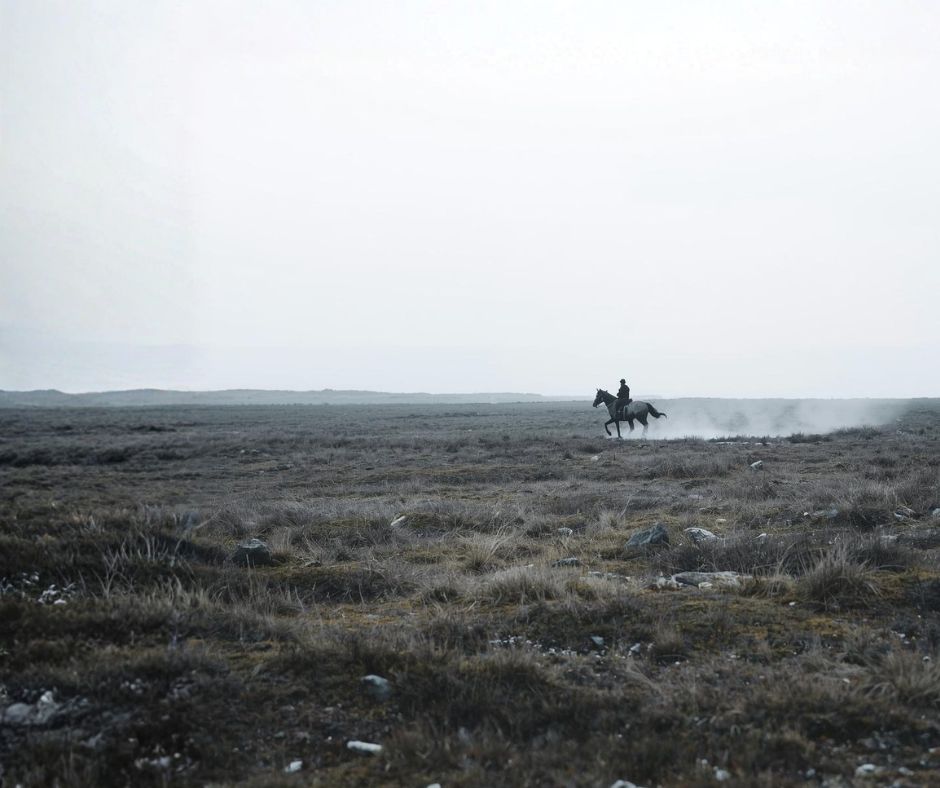
Ehwaz appears as a horse without destination.
Movement without arrival.
An impulse that demands response.
A rhythm that keeps the body in motion.
In the shadow of Flight, Ehwaz may show itself as:
- restlessness that does not allow stopping
- the sense that standing still would be dangerous
- movement for the sake of movement
Like a horse running across an open field —
not toward a goal,
but because stopping is not yet possible.
This is not a mistake.
It is the body’s intelligent way of staying alive.
The turn does not come from stopping
A turn is not born from forcing stillness.
Flight does not need pressure or explanation.
What matters is the moment
when the body can catch up after movement.
Eihwaz – movement with an inner axis
Eihwaz does not say, “Stay where you are.”
It says:
“Remain present, even while moving.”
It is the inner axis
that does not disappear during a change of direction.
Eihwaz allows you to:
- move without losing yourself
- decide without scattering
When the axis is present,
you can continue moving.
Raidho – movement with direction
When movement has already occurred,
there is no need to go back.
What matters is understanding
where you are now
and where this movement is actually leading.
Raidho restores sequence.
It reconnects beginning and destination,
so body and mind arrive in the same place.
When movement has direction,
it no longer has to carry the full weight of survival.
In closing
If you recognize yourself in this story, know this:
This pattern does not make you wrong.
It formed so that you could survive.
You do not need to change anything today.
It is enough to notice
when the body wants to move before presence arrives.
And one day — in your own rhythm —
the body may discover
that movement no longer has to carry the weight of life on its own.
This is one of the ways the nervous system learned to survive — you may recognize others as well:
📘 Book that honor the body’s wisdom
If this post resonated with you — especially the themes of movement, distance, and the need to orient after leaving — this book offers a grounded and compassionate perspective on trauma and healing:
- Waking the Tiger: Healing Trauma — Peter A. Levine & Ann Frederick
A body-based exploration of how survival responses live in the nervous system, and how healing unfolds through safety, pacing, and gradual reconnection rather than force or control.
🜂 Supportive Rune Pendants for Your Journey
Inspired by the runes woven through this post, these symbolic pendants can serve as quiet companions — worn close or placed in a personal space as reminders of orientation and presence:
- Eihwaz — to remain connected to yourself while in motion
- Raidho — to support movement with direction and continuity
Choose what speaks to you.
Your path does not need to look like anyone else’s — only to honor your pace and your presence.